AI Math Program Tested in Bogotá Public Schools Shows World-Class Preliminary Results
1 Jul 2026 · 8 min lectura
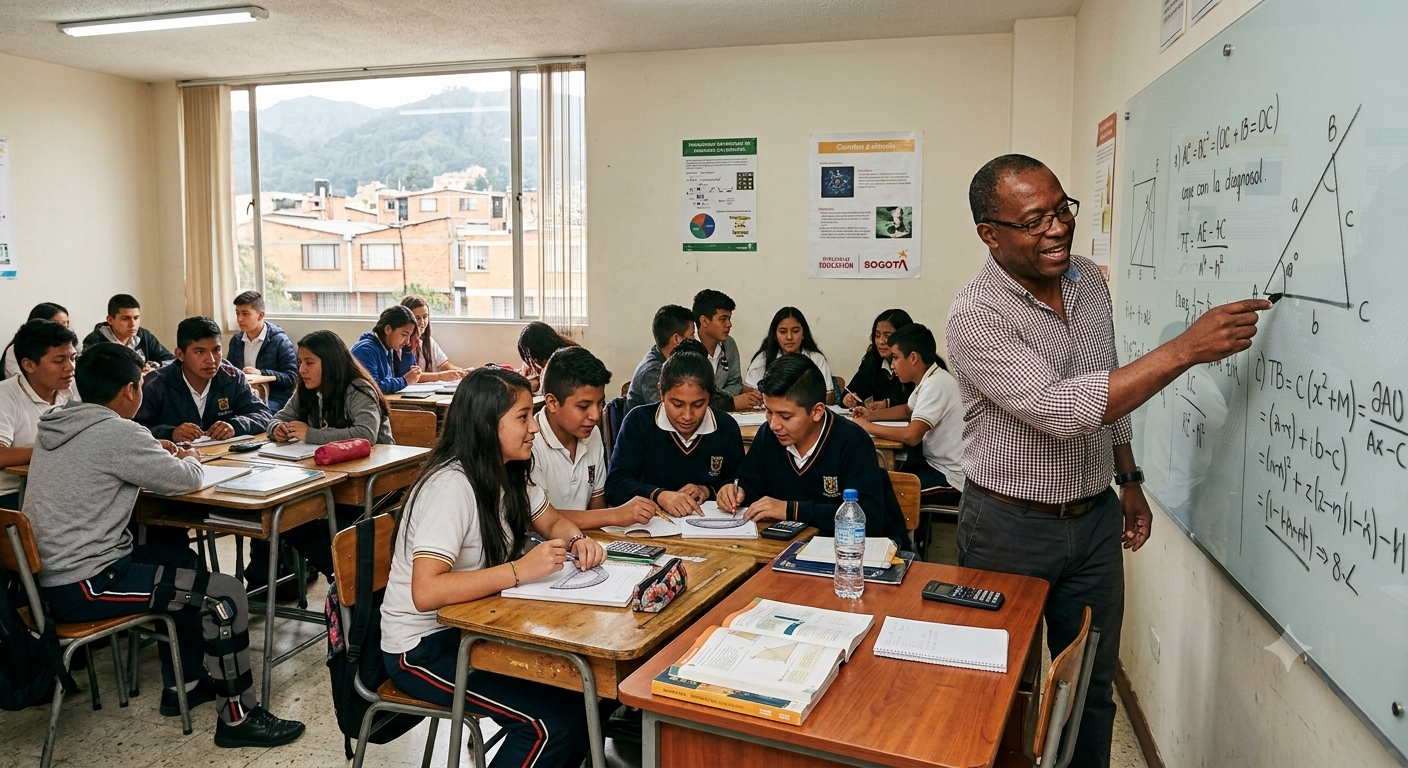
For years, one of the most difficult questions in education has been how to achieve significant improvements in learning without depending on models that are impossible to scale.
How can we better support teachers? How can we respond to the diversity within the classroom? How can we strengthen mathematical skills beyond memorization? And how can we do this in public education systems with real constraints of time and resources?
Between 2025 and 2026, over a five-month period, MentuLabs, in partnership with the Shaia Foundation and the Bogotá Secretary of Education, worked to explore some of these questions through a pedagogical intervention that combined artificial intelligence, teacher support, and a “Mathematics for All” approach.
Preliminary results from the evaluation show promising signals.
An intervention centered on teaching practices
The project worked with mathematics teachers in grades 6-9 in public schools in Bogotá, combining three elements:
- AI-based tools to support pedagogical planning.
- Situated teacher support.
- A pedagogical approach centered on reasoning, problem-solving, and active student participation.
More than 20,000 students were exposed to the intervention. The goal was to use AI to help teachers design more open, participatory math experiences that were sensitive to classroom diversity.
The evaluation was independent and led by Juan Muñoz-Morales, professor at IÉSEG School of Management, and Felipe Barrera-Osorio, professor at Vanderbilt University, with support from Innovations for Poverty Action (IPA). Additionally, the evaluation was funded by the Jacobs Foundation, allowing it to be implemented under high standards of impact measurement.
What did the evaluation find?
Preliminary results show positive improvements in mathematical learning for students in the treatment group compared to the control group. The intervention showed improvements of between 0.22 and 0.46 standard deviations, depending on the analysis methodology applied.
In educational terms, the gains were concentrated in problem-solving and the random component of the test.
Additionally, the analysis found an important relationship between intensity of use and results: teachers who used Shaia most frequently tended to see better results with their students.
Technology alone does not explain the impact
Another key finding is just how cost-effective the intervention proved to be. The program delivered learning gains equivalent to between 0.22 and 0.46 standard deviations, at an approximate cost of just USD 9.14 per student. For context, the average effect across more than 150 experimental education evaluations analyzed by the World Bank sits around 0.1 standard deviations (Angrist et al., 2020).
In other words, the results from Bogotá land between two and four times above that international benchmark — while keeping implementation costs remarkably low. Put differently: the program generated each 0.1 standard deviation of improvement for roughly USD 2.30 to USD 4.60, compared to international ranges that typically run between USD 10 and USD 50 for similar impact.
None of this means there’s a silver bullet, or that the challenge is solved. But it does suggest that it’s possible to build models that combine impact, sustainability, and scalability within public education systems.
A potentially cost-effective model
Another relevant finding is the level of cost-effectiveness observed. The intervention achieved an effect size between two and four times larger than the global average of more than 150 controlled education experiments, at a cost of USD 9.14 per student—well below the typical range of comparable interventions (USD 10 to 50 per 0.1 standard deviation of impact, according to Evans and Popova, World Bank, 2016).
This is especially important in contexts where the challenge is not only achieving impact, but building sustainable and scalable models for public education systems.
What’s next?
The findings are beginning to show that it is possible to build models where artificial intelligence, pedagogy, and teacher support work together to strengthen learning.
The challenge now is not only technological, but pedagogical, institutional, and human: how to design tools and implementation models that truly help teachers transform learning experiences in the classroom.
And here emerges one of the most important opportunities for Latin America—it is not simply about incorporating AI into the education system, but using it to build more inclusive, more participatory, and more effective learning experiences for teachers and students.
For additional information, you can read the complete working paper, published by the researchers.
MentuLabs Team